


Chuck Tyler only stayed in the hospital a few hours after his surgeon removed a tumor from his stomach. Tyler, 85, described pain after surgery as a level 1 out of 10.
“It was like having a baby tooth pulled,” said Tyler, who lives in Sunnyvale, California. “It was duller than dishwater.”
His quick recovery was made possible thanks to robotic surgery.
Maureen Tedesco, MD, FACS, a general surgeon at the Kaiser Permanente Santa Clara Medical Center who performed Tyler’s procedure, said robotic surgery requires much smaller incisions than other types of surgery. The minuscule openings cause less damage to a patient’s tissues.
Getting back to what matters most
“Patients can get back to what they enjoy sooner,” said Dr. Tedesco, who is also regional medical director of specialty care at The Permanente Medical Group. “Our members can get back to hiking, riding a bike, walking their dog, or spending time with family and friends.”
Instead of the large opening needed in conventional surgery, robotic surgery uses 3 to 5 tiny cuts. Robotic surgery patients are 75% less likely to need a blood transfusion when compared to traditional, open surgery, according to a study published in the Annals of Surgery in 2025. The same study found 44% fewer complications. Because patients can move around sooner, they are at lower risk for blood clots, infections, and pneumonia.
“Open surgery has a higher complication rate, longer recovery, more pain, and longer hospital stays,” Dr. Tedesco said. “With robotic surgery, patients are also less dependent on pain medicine.”
Bringing robotic surgery to more patients
The general surgery robotics program began in Kaiser Permanente Northern California in 2014. The first robotic general surgeries were focused on the esophagus, adrenal glands, and complex abdominal wall procedures.
The general surgery robotics program has grown significantly since then. It now includes surgery on hernias, colons, spleens, stomach, and gallbladders. It is also now available for emergency operations. Beyond general surgery, a robust robotic surgery program features procedures across multiple specialties, including urology, gynecology, gynecologic oncology, thoracic, and head and neck.
Dr. Tedesco said she hopes it will soon be available at all Kaiser Permanente locations throughout Northern California.
“We’re getting there,” she said.
Enhancing, not replacing the surgeon
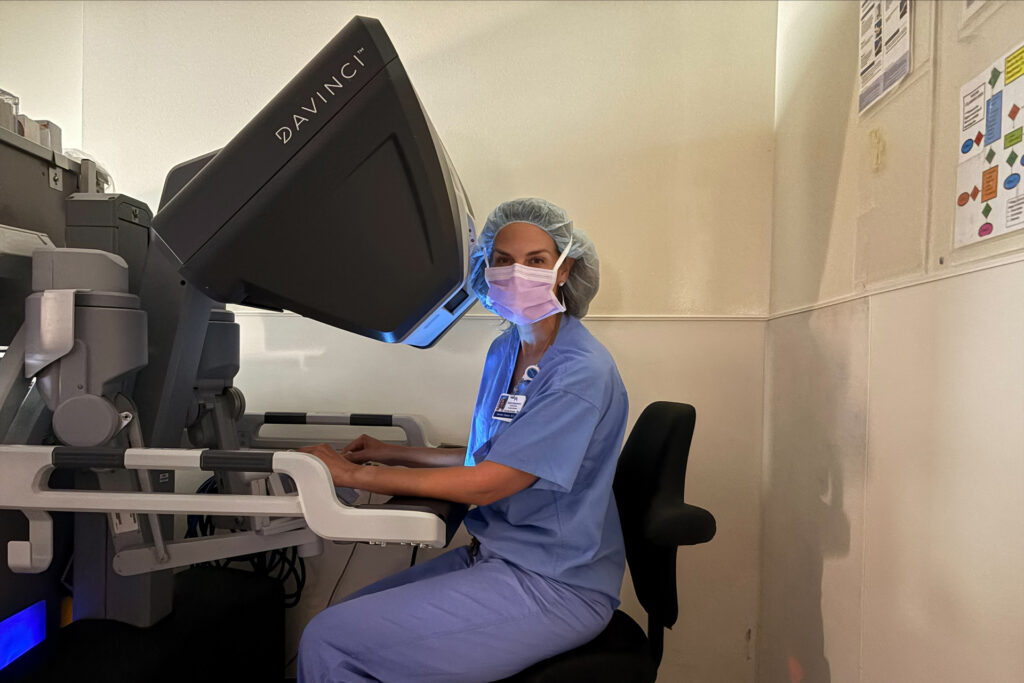
With robotic surgery, the surgeon manages the operating instruments from a nearby control station. The surgeon looks at a magnified, high-definition, 3D image of the operating area. The better view lowers the risk of injury to nearby organs during surgery. The surgeon’s hands guide the robotic instruments inside the small incisions.
“With the robot, everything is led by the surgeon. It doesn’t replace any of my surgical judgment,” Dr. Tedesco said. “This is another tool in the toolbox, just like scissors and scalpels.”
Controlled by the surgeon, a robot can make precise movements in narrow spaces, giving them better access to hard-to-reach areas of the body.
“Using the robot, I could peel a grape,” said Dr. Tedesco, who is also clinical associate professor of surgery at Kaiser Permanente Institute of Medical Education.
Inside the surgery
“It’s like I’m shrunken and placed inside the patient,” Dr. Tedesco said. “Although the surgery is minimally invasive, on my end it feels more like open surgery.”
Tyler, who has been a Kaiser Permanente member for more than 20 years, has had other surgeries in the past. He said they all caused much more pain, and he took longer to recover compared to the robotic tumor removal.
“There was nothing unpleasant about the robotic surgery,” Tyler said. “I woke up and felt like myself.”