

There was a time when Gene delayed making appointments to get his skin spots examined. He found the process inconvenient.
When he noticed a spot, he’d request an appointment with his personal doctor. After waiting for the appointment, his doctor would let him know if he needed to see a dermatologist. Then, he’d wait again for that specialty appointment.
“I didn’t go in unless I had several spots or a serious concern,” said Gene, who has been a Kaiser Permanente member for more than 50 years. Gene asked to only use his first name.
Quicker path to skin care
Gene no longer waits. He now uses the Kaiser Permanente teledermatology program.
“It’s much more patient friendly,” said Gene, who lives in San Jose. “I send a message to my doctor as soon as I notice a spot.”
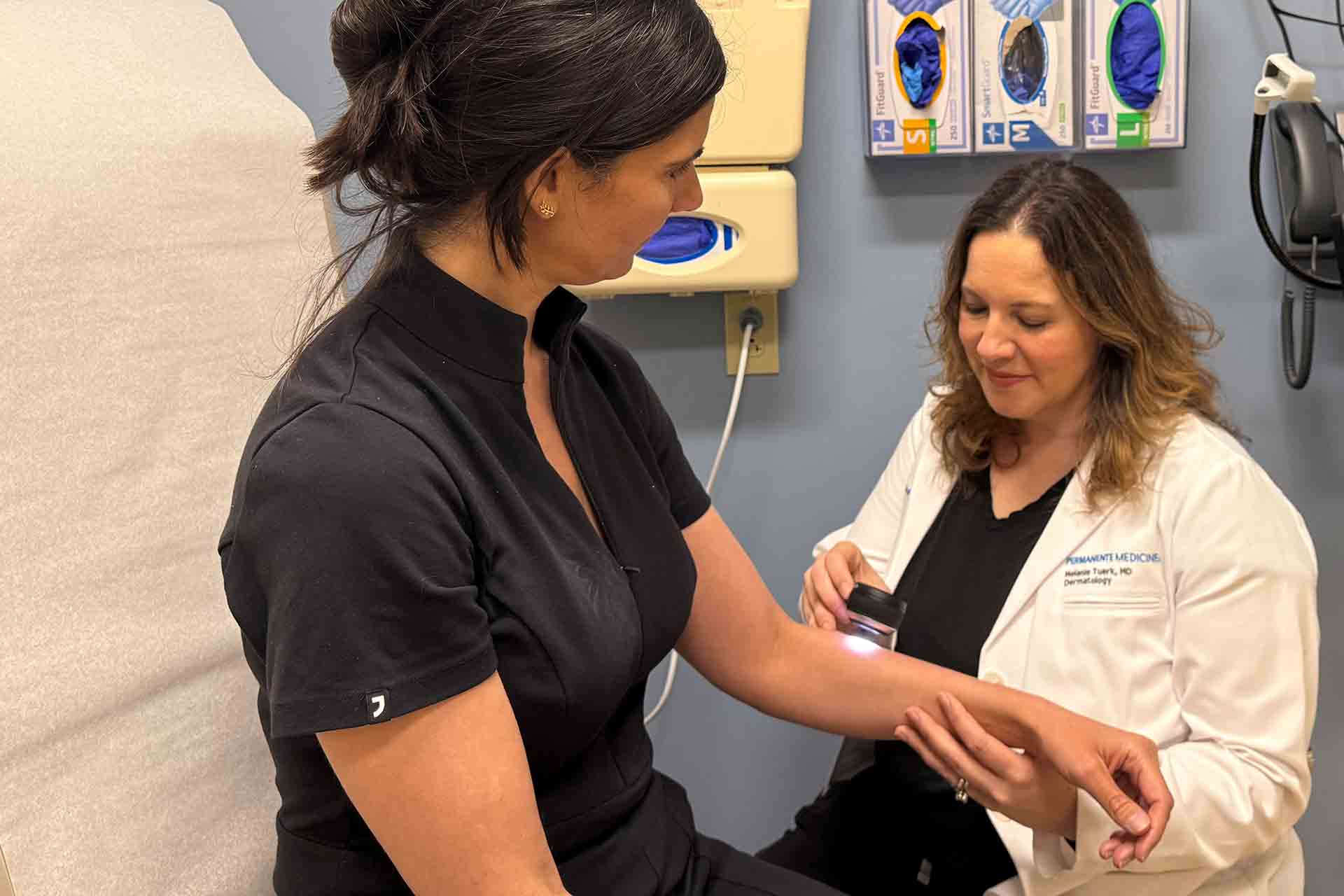
In the teledermatology program, the patient’s skin is photographed at their personal doctor’s office. Photos are taken with a regular camera and a device called a dermatoscope, which magnifies the skin and uses special lighting to view beyond the top layer. A dermatologist reviews the pictures and then decides if the patient’s condition needs to be examined in person by a dermatologist.
If a follow-up is needed, the dermatologist usually responds within one business day and sometimes sooner.
“I get answers very quickly,” Gene said.
Program has grown to receive international recognition
Teledermatology started in Kaiser Permanente Northern California in 2011. It has expanded how many patients can get rapid advice from dermatologists. The program reviewed photos from 150,000 patients in 2018. In the past few years, that annual number has grown to 350,000 patients. About two-thirds of the time, a dermatologist can give treatment advice without the patient waiting for an appointment.
Kaiser Permanente’s program built a strong reputation in the U.S. and worldwide. The program’s design and data have been presented at major international conferences, and its results have been published in medical journals.
Melanie Tuerk, MD, medical director for dermatology virtual care, said teledermatology expands access for members.
“Nationwide, dermatology is a small specialty,” Dr. Tuerk said. “This program gives patients answers quickly. It also allows patients to consult with a specialist even if there isn’t a dermatologist readily available in their area.”
Patients’ information is sent securely and quickly. And issues are sometimes more accurately identified. A 2019 Kaiser Permanente study found that the program identified nearly 10% more skin cancers, which allowed for earlier intervention. Also, 40% of the time, it addressed patients’ skin care needs.
“Dermatology is a visual specialty,” Dr. Tuerk said. “During our training we learned by seeing patients and by reviewing photos of skin conditions. We’re comfortable providing a diagnosis and advice after reviewing photographs.”
Learning through collaboration
Sphoorti Umarjee, MD, is a pediatrician in San Jose who has worked with the teledermatology program since 2017.
 “It helps me be a better clinician,” Dr. Umarjee said. “From reading the dermatologists’ responses, I am now able to identify some rarer skin conditions. I also use some of their wording to prepare my patients for what to expect with treatment.”
Dr. Umarjee said her patients have been pleased to get answers swiftly.
“Sometimes patients are worried. They are very appreciative and impressed that they get answers so quickly instead of waiting to see a specialist,” Dr. Umarjee said. “Having access to the teledermatology program increases my joy in medicine.”