



Many patients seeking care for common outpatient conditions selected a simple online e-visit rather than talking to a doctor in-person, by phone, or by video, according to a Kaiser Permanente analysis published in JAMA Network Open.
The study also found that Kaiser Permanente Northern California members who chose electronic visits had low rates of follow-up care in the following 7 days, comparable to follow-up rates of other types of visits.
The findings support the rapid expansion of e-visits for patients to get convenient medical care round the clock for a growing number of straightforward health complaints, the authors said. As an integrated system, Kaiser Permanente is able to provide remote care with a patient’s own doctor and electronic health record.
“Electronic visits are popular with patients, particularly those in their 20s and 30s, though these types of visits are used robustly by all age groups up to 65,” said senior author Mary E. Reed, DrPH, a research scientist with the Kaiser Permanente Division of Research. “It’s good to find out that the need for follow-up care is similar to other types of visits.”
Choices on how to receive care
E-visits in Northern California can be initiated anytime through the health system’s online portal. When choosing an e-visit, the member answers questions.
The answers are then reviewed by a health care professional, and the member receives a response by secure message within 4 hours, and usually sooner.
The response may include medical advice, a prescription for medication, a recommendation to follow-up with a medical visit or to call a specialized advice line, such as the international travel clinic.

E-visits are currently available for about 30 health concerns for patients in Northern California, and new e-visits are being added regularly, said co-author Khai Tran, MD, medical director for the region’s Virtual Care Program. “It’s a great, convenient, safe choice for most patients,” he said.
For many health issues, patients can choose one of several options for care: an e-visit, a phone or video call with a doctor, or an in-person visit.
“We want our patients to choose the optimal type of visit to deliver safe, high-quality care,” he said.
The study analyzed visits during 2024 for 3 common health issues: urinary tract infection, seasonal allergy, and acne, plus advice for international travel.
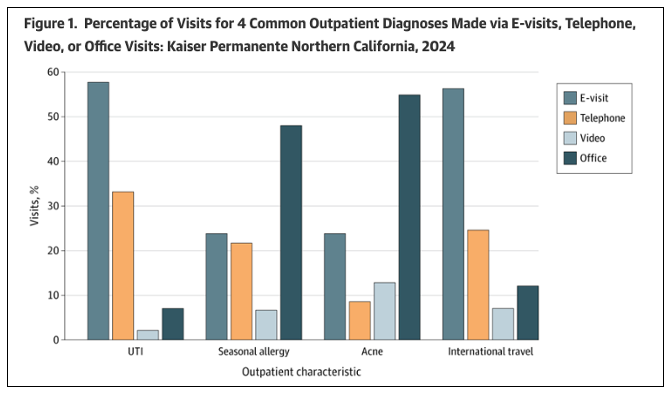 E-visits were chosen by 58% of patients with urinary tract infections, 56% of patients seeking advice in advance of international travel, 24% of patients with seasonal allergy symptoms, and 24% of patients with acne.
The rates of follow-up care within the 7 days of an e-visit were under 7% for the 3 conditions and advice on international travel.
More e-visit topics in pipeline
The e-visits are regularly reviewed and updated to follow evolving medical guidelines. For example, the cough, cold, and flu e-visit will now include a question about whether the patient has taken a home test for flu, with an option for a prescription for Tamiflu if the patient qualifies.
Meanwhile, the Virtual Care program is regularly developing new e-visit types, with more than a dozen in the pipeline.
“Our team thinks about what topics would lend themselves to being developed into an e-visit, and we are regularly approached by our colleagues in primary and specialty care with ideas for new topics,” said co-author Dao Nguyen, MD, medical director of the regional International Travel Clinic.
Dr. Nguyen noted that the growing set of e-visit options are gaining users, but patients should know that they can always select a different type of visit. “Our physicians are there to support you,” he said.