


Ever wonder what’s the most common consumer product kids put up their noses that require removal by emergency room professionals?
“That would be jewelry, but we don’t know why,” said Pauline Huynh, MD, a head and neck surgeon in residency at the Kaiser Permanente Oakland Medical Center who presented data to a recent meeting of the American Academy of Otolaryngology — Head and Neck Surgery.
Dr. Huynh and colleagues scoured US Consumer Product Safety Council data for their report. One goal of the research is to make parents aware that little things within reach of children can cause big problems.
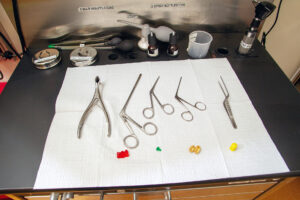
Here’s some of what they found: The mean age of children who visit emergency rooms for objects in their noses is 3. After jewelry, little kids are fond of paper products, desk supplies and stationery, toys, and the dreaded button-size battery. Batteries are alarming because they can leak acid and damage mucosal surfaces in the nose, throat, esophagus, and stomach.
“Anecdotally here in Oakland, it seems like small beads and Legos also are popular,” Dr. Huynh said.
Dr. Huynh was guided in the research by Jonathan Liang, MD, also a head and neck surgeon, and associate professor at the Kaiser Permanente Benard J. Tyson School of Medicine in Pasadena. The team of 4 researchers, including Samuel Collazo, MD, and Luke Schloegel, MD, also found the rate of emergency room visits for things stuck in noses has not changed much over roughly 20 years, with 690,196 cases reported from 2004 to 2023.
Those numbers only reflect consumer products.
“We also see coins, a lot of nuts, and pieces of fruit like apples and grapes,” said Dr. Huynh. “My colleagues have removed key rings, fish bones, and seeds.”
The good news is that nearly all items, 96% can be removed in the emergency room, according to the data, said Dr. Huynh.
“Batteries are 6 to 20 times more likely to involve some kind of intervention beyond the emergency room,” said Dr. Huynh, who estimated she has performed surgeries on 12 to 15 little people over the last 5 years who have an object so far up their noses it requires sedation. “Very uncommonly things can go into the lungs, esophagus, or stomach.”
Huynh said clinicians use instruments to remove items from the nose. If an item is in an airway or the esophagus, the kid is sedated, and extraction is through the mouth.
Dr. Liang, who has been at Kaiser Permanente 13 years and who mentors head and neck surgeons, said he was not surprised by the findings, but the information is important for public awareness.
“The little batteries are the things parents need to make sure kids don’t have at their fingertips,” said Dr. Liang. “It’s not something parents need to be embarrassed about if their kid does put a battery in their nose. It happens.”