

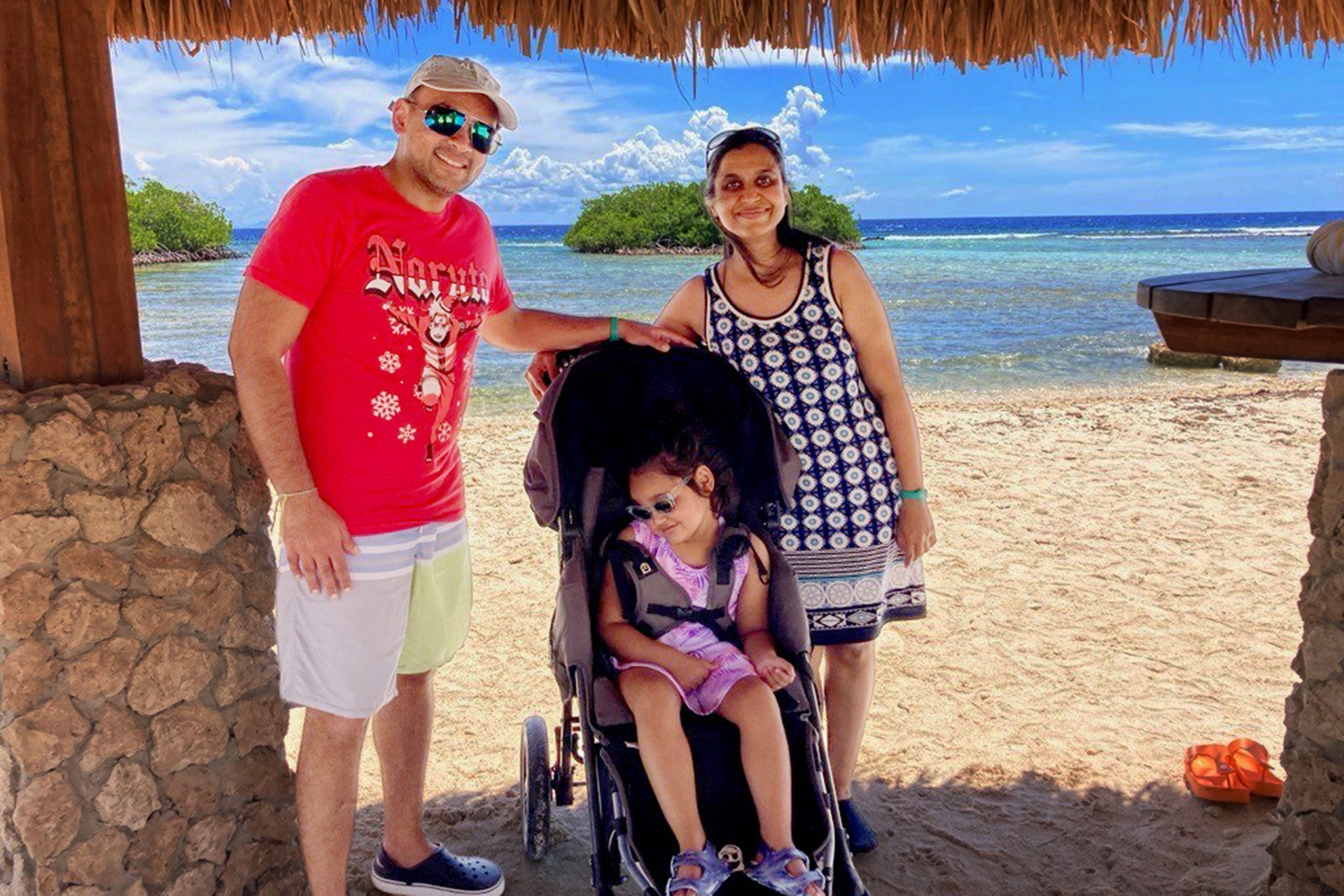
Reyna Jogani enjoys traveling the world. The 8-year-old is an avid water sports enthusiast, a young fashionista, and a self-proclaimed Swiftie, who dressed as singer Taylor Swift last Halloween. She loves jewelry, doing her nails, surfing, and rollercoasters.
When she was an infant, Reyna was diagnosed with a rare neurological condition — CDKL5 Deficiency Disorder. This disorder affects about 1 in 40,000 children. It can cause developmental delays and seizures when the CDKL5 gene is missing or not working properly.
Over the years, Reyna has received care and treatment from Kaiser Permanente Milpitas pediatrician Faeza Khan, MD and Kaiser Permanente Santa Clara Pediatric neurologist Ann Lewis, MD.
The two have formed a close bond with the little girl.
“Everything about Reyna is special,” Dr. Khan said. “She holds a very special place in my heart. Reyna almost always has a smile on her face, which brings a smile to my face. Her personality is like sunshine.”
Compassionate care at Kaiser Permanente
Living with such a rare genetic disorder is challenging but having exceptional care helps, said Reyna’s parents, Shruti and Jainu Jogani.
Reyna’s doctors and other specialists have identified adaptive gear that helps her to play sports, and they also have kept the Joganis updated on the latest research and clinical trials.
“We have so much confidence in Reyna’s care team at Kaiser Permanente,” Shruti Jogani said. “Her doctors are like family, and our entire experience has been life changing.”
Dr. Lewis had treated a few other patients with CDKL5 Deficiency Disorder before meeting Reyna, although the condition is rare.
“Reyna’s developmental progress has required optimizing control of her seizures. This has been the most challenging part of our role in her care,” she explained. “As Reyna has progressed with her development, it has been a joy to see more aspects of her personality emerge — particularly her curiosity, determination, and sense of humor.”
As for Dr. Khan, Reyna was her first patient with CDKL5 Deficiency Disorder. She manages Reyna’s care, referring her to neurologists, pediatric nutritionists and other specialists.
“It was a crash course in managing a complex patient,” Dr. Khan said. “I had worked with patients with seizure disorders, but not CDKL5 Deficiency Disorder. This has been a team effort for us.”
Dr. Khan has cared for her since she was 2 months old, when her seizures began.
“I’m amazed and inspired by Reyna’s journey,” Dr. Khan said. “Jainu and Shruti are devoted parents, and Reyna gets her determination from them.”
Aspiring for the best
The Joganis are paying it forward by promoting CDKL5 deficiency awareness and research.
They quickly learned that progress in rare disease research often moves slowly. Rather than wait, they founded Child’s Cure Genetic Research, a nonprofit organization, to accelerate science and bring meaningful therapies closer to children like Reyna.
“Our foundation exists to close the gap between promising science and real-world access,” Shruti Jogani said. “Reyna’s resilience continues to inspire this work, and our goal is simple: to transform urgency into action so that families facing rare genetic disorders have real treatment options. Our foundation is very close to gene therapy. These are exciting times.”
She also offers advice to parents who are in a similar situation.
“I would like to ask them not to limit their children. Don’t take no for an answer and always aspire for the best for your children. Don’t assume that because there isn’t a cure right now, there won’t be one in the future.”