


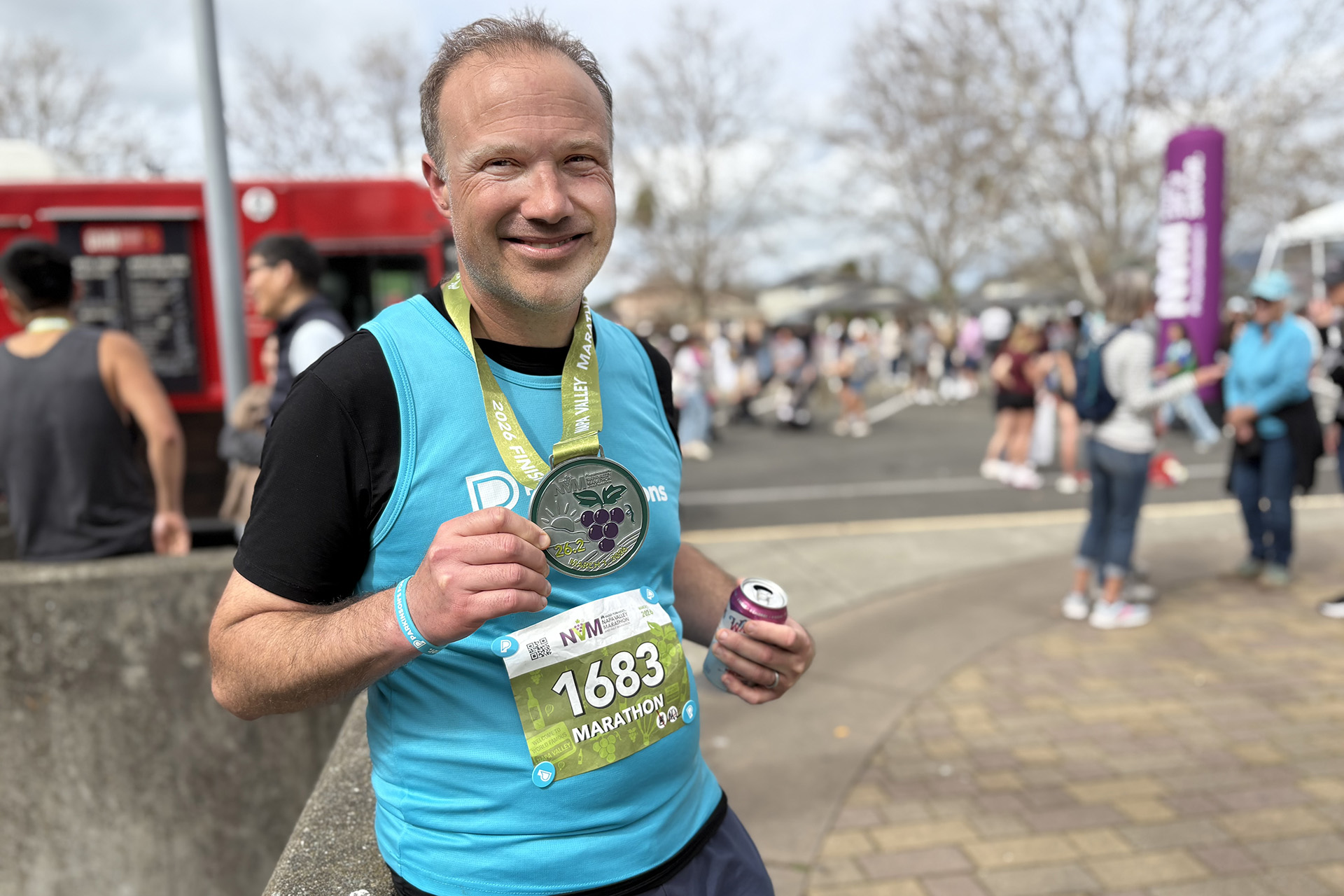
Michael V. Lasker, MD, PhD, was out running last fall when he had an idea to honor his friend, mentor, and childhood coach who had died recently after a long battle with Parkinson’s disease.
In 1987, Lawry Drake, a swim coach on the Napa Valley Swim Team, took the future physician under his wing and started running with him.
They ran the Napa Valley Marathon when Dr. Lasker, now a general surgeon at Kaiser Permanente Santa Rosa Medical Center, was 11 years old. (He completed his first marathon at age 8.)
Drake died last fall at age 82.
“After the memorial for Lawry, I thought it would be cool if I ran this marathon again 39 years later in Lawry’s honor and raised money for Parkinson’s disease,” recalled Dr. Lasker. “I thought I could raise $3,900 for 39 years.”
In Drake’s honor, Dr. Lasker finished the Napa Valley Marathon on March 1, at age 50, in 4 hours, 54 minutes and 30 seconds, and met his donation goal to the Parkinson’s Foundation. Dr. Lasker has run 8 marathons so far.
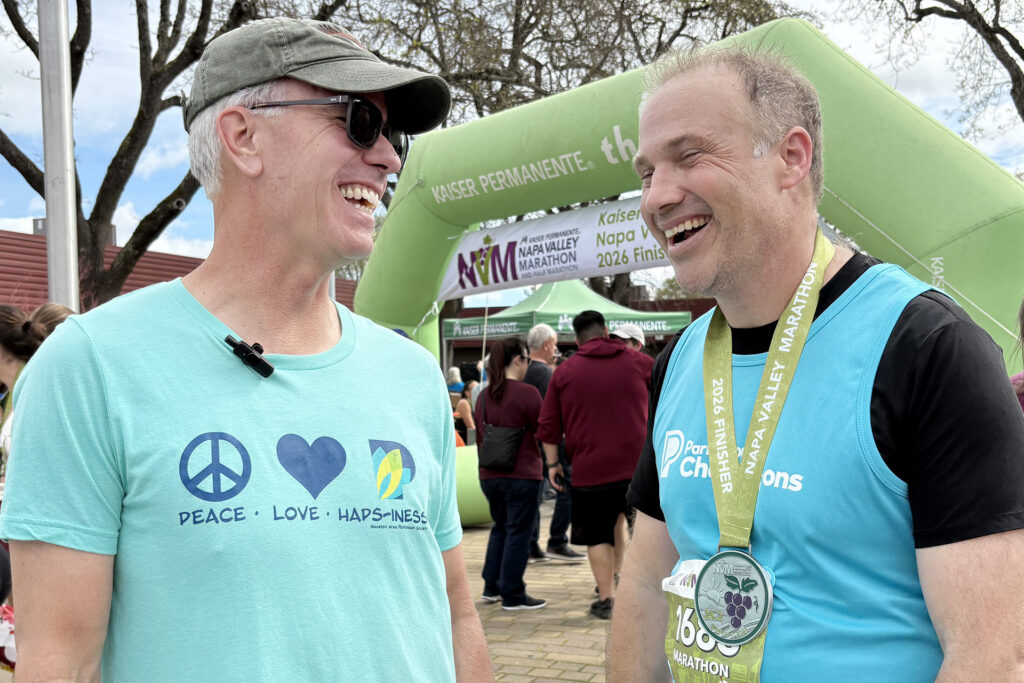
At the most recent marathon in Napa Valley, Drake’s son, Paul Drake, was at the finish line to support Dr. Lasker.
“We’re extremely grateful that Michael did this, partly as a fundraiser for Parkinson’s disease, but also for me, to honor my dad and his struggle,” said the younger Drake. “There’s a lot of history Michael had with my dad running and my dad being his swim coach.”
Starting young
Dr. Lasker said he began training with Drake when the elder man overheard him talking about how he wanted to beat the time of his first marathon.
“He would run over to my house before school, and we would run.,” said Dr. Lasker. “I had a hard time waking up for school, but running motivated me to get out of bed.”
Dr. Lasker said like any coach worth his salt, Drake was a great strategist, something very important for running marathons. That coaching stayed with him over the years.
“He was methodical about his pacing and times and taking notes about runs,” said Dr. Lasker. “He was meticulous. Even as a swim coach. He said: ‘If you want to do this marathon in less than 4 hours, we have to shoot for less than 9-minute miles.’ We hit it on the nose.”
Over the last 39 years, Dr. Lasker has committed to staying in shape enough that he could start training for another marathon when he felt it was time. Running a marathon is dear to him, partly for the memories and partly because it’s such an accomplishment.
“You have to put in the effort to build a strategy, and then there’s the training,” Dr. Lasker said. “It’s a special group of runners who do it. There’s a lot of runners in the world, but only certain people run marathons, and that’s what I like.”
Chyresse Hill contributed to this report.